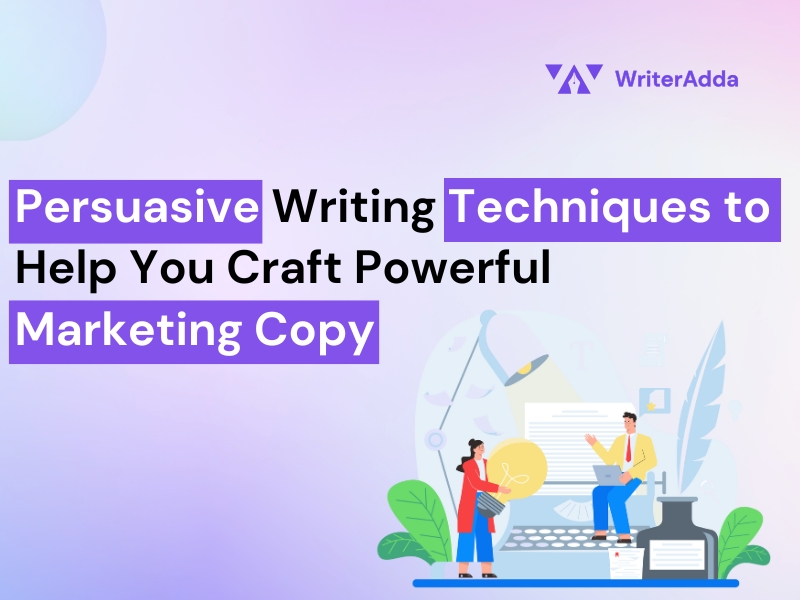
In the competitive world of marketing where snackable, bite-sized content gains viewers’ attention, it can be daunting to convince your target audience. The ability to stand out in the crowd is crucial and your words might be the answer. Persuasive writing not only captures attention but also drives action, which is crucial for achieving marketing goals. Combining artistic elements, analyzing audience psychology, selecting the right words, and being marketing savvy can help you develop content that resonates with your target audience.
Whether you’re crafting email campaigns, social media posts, or landing pages, mastering these persuasive writing techniques will elevate your marketing approach from good to irresistible. Follow this article and delves into the detailed process of persuasive writing techniques, the right approach to your online content.
What is Persuasive Writing?
Persuasive writing is a format or style of writing where the author attempts to influence the reader’s thoughts, beliefs, or actions but not in a manipulative way! It is written using factual data, logical arguments and emotional appeal to sway the audience towards a desired course of action. In short, persuasive writing makes your case more appealing and makes sense to your readers.
Key elements of persuasive writing include:
- A clear thesis or main argument
- Supporting evidence and examples
- Logical reasoning
- Emotional appeal
- Addressing counterarguments
- A strong call-to-action
Why Learn Persuasive Writing?
Have you ever read a blog or an article that made you question your own notions? But you are rational, and you don’t let your emotions sway, but something changed your perspective and challenged your beliefs. Persuasive writing influence does not manipulate decisions, it provides logic and factual data to appeal your emotion.
To understand this better, think of the last time you went grocery shopping. You likely had a list and a budget to help you stay focused. But as you shopped, your eye caught a sign: “Set of tissue paper just for $3.” Although you already have two extra bundles at home, the appealing price makes you add it to your cart. Persuasive elements like these often guide us to make decisions we hadn’t planned on.
Learning persuasive writing is invaluable in today’s communication-driven world. This skill enables you to effectively convey ideas, influence decisions, and drive action across various personal and professional contexts. Mastering persuasive writing techniques not only improves your ability to express yourself clearly and convincingly but also sharpens your critical thinking skills as you learn to analyze and construct persuasive arguments.
Strategies to an Effective Persuasive Writing
Know Your Audience
Before you write a single word, it’s crucial to understand who you’re writing for. A persuasive copy speaks directly to the reader’s needs, desires, and pain points. Start by answering these questions:
- What does my audience care about?
- What motivates or worries them?
- How does my message align with their values?
A tailored approach to writing a copy can enhance the quality and won’t be an eyesore for your readers. For example, understanding who you are writing for can help you craft a copy that will deeply resonate with them.
A Strong Hook and a Compelling Story
Remember, you have mere seconds to grab your reader’s attention. Your story should start with a boom! The opening line must be compelling enough to stop readers in their tracks and ignite the fire of curiosity.
Start with a question, a bold statement, or an interesting fact to capture readers’ attention. For example, “Did you know that people are 70% more likely to buy a product when it is narrated through a relatable story?”
The hook might grab your readers’ attention but if your story doesn’t lead anywhere, all your hard work will go to waste. Stories are ingrained in our blood; we love and live each story through our imagination. Your writing must tell a story, as each line will be built on the last you will convince your reader through your reasoning and logic. All this will finally lead to your main motive: CTA or call to action. Whether it’s “subscribe,” “learn more,” or “make a change,” make sure your closing words are memorable and motivating as your hook.
Focus on Benefits, Not Just Features
While it’s tempting to list all the amazing features of your product or service, what really persuades people are the benefits – how those features will improve their lives. For every feature you want to highlight, ask yourself, “So what?” Does this information will affect your reader?
While features are about what a product has, benefits show what it does for the user and can make their life easier. There’s a big difference between these ideas. While features rely solely on facts, benefits give readers a reason to believe that your product or service is exactly what they’re missing. Highlighting benefits shows that your offering isn’t just a set of features—it’s a solution that adds value and hope, making life better.”
The PAS Formula
The Problem-Agitate-Solve (PAS) formula is a classic persuasive writing structure that works well in various marketing contexts:
- Problem: Identify a problem your audience faces
- Agitate: Elaborate on the problem, stirring up emotions
- Solve: Present your product or service as the solution
The PAS formula taps into human psychology by first creating empathy and then offering a clear path to resolution. It doesn’t just sell a product or idea; it harnesses the core emotions and turns a passive reader into an engaged one. Arousing emotions will compel your readers to react to your content with intensity. Make your readers arouse emotions be it anger, happiness, nostalgic or surprise to add volume to your motive.
NOTE: A negative marketing is still marketing.
Leverage Social Proof
Humans are social creatures, and we’re more likely to act when we see others doing the same. Incorporate social proof into your copy through:
- Customer testimonials
- Case studies
- User statistics
- Expert endorsements
- Awards and recognition
A reader becomes a customer when it finds value in your product or service and social proof acts as a credible source to gain your reader’s trust. It is like the quote goes: “Monkey sees, monkey do”, when a large group of people recommend you a product it is inevitable to get it out of your mind. For example, when a celebrity endorses a product, it suddenly gains a premium status. Even if a cheaper, non-branded version offers the same features, the desire to own the branded item increases because of the perceived value and credibility enhanced by the celebrity.
Create a Sense of Urgency and Exclusivity
Creating a sense of urgency and exclusivity is a powerful strategy that taps into psychological triggers like FOMO (Fear of Missing Out) and scarcity. When customers believe that an offer is time-sensitive or that a product is in limited supply, they feel compelled to act quickly before the opportunity disappears.
Using phrases like “limited time offer,” “only a few lefts,” or “hurry, while stocks last” conveys urgency and prompts immediate action. These phrases give the impression that the clock is ticking, and the offer might not be available later, driving people to purchase or engage right away.
Exclusivity also plays a key role in motivating customers. Positioning an offer as exclusive — for instance, “members-only access” or “VIP-only deals” — makes customers feel special and valued. This sense of belonging creates an emotional bond that makes the offer more desirable.
It’s essential, however, to be truthful and transparent when creating urgency. If a deal isn’t truly limited or a product isn’t really in short supply, falsely creating urgency can lead to dissatisfaction, a loss of trust, and potential customer backlash. Always ensure that the urgency is real and avoid using deceptive tactics that could harm your brand’s reputation.
Optimize for Fast Readers
While your content must address tit and bits that can lead your readers to take action, most readers skim content before deciding to read in-depth. Making your copy easy to scan can encourage them to go through your entire content or simply to take the desired action. You can:
- Use short paragraphs
- Incorporate bullet points and numbered lists
- Adding subheadings to break up text
- Bolding key phrases
You can even add bold surprising elements to hook them in your content. Instead of persuading them, for your fast readers add words that order them. For example; instead of May/maybe, should, perhaps or try, use you must, you have to, you need to, or I believe to amplify your influence.
Use the Curiosity Gap
Pique your reader’s curiosity by hinting at information without fully revealing it. This creates a “knowledge gap” that motivates them to keep reading or take action to learn more. Use phrases like:
- “You won’t believe what happened next…”
- “The secret to X is simpler than you think…”
- “Discover the unexpected way to achieve Y…”
We can call this the “anchoring effect.” To simplify, we are often lured by prices like “$99” or “Get 2 for just $9.” Why? We develop a perception that a product’s price should fall within a certain range. When we see a product offered at a lower price than expected, it hooks us. Therefore, it’s crucial to understand this psychological trigger and leverage knowledge gaps to effectively pitch your product or service.
Test and Edit
Editing isn’t just about fixing errors—it’s about crafting a message that hits home. Start by trimming the fluff, cutting unnecessary words, and replacing weak verbs with stronger ones to make every sentence count. Read your copy aloud to catch awkward phrasing or missed opportunities. Once you’ve honed your message, take it a step further with A/B testing. Experiment with different headlines, openings, benefit statements, and CTAs. Use the insights from your tests to refine and optimize your approach, ensuring your copy continually engages and drives action. It’s all about maximizing impact with every word.
Conclusion
Mastering persuasive writing techniques is an ongoing process that combines creativity, psychology, and data-driven optimization. By understanding your audience, focusing on benefits, using proven structures like PAS, and incorporating elements like social proof and urgency, you can create marketing copy that truly resonates and drives action.
Remember, the most persuasive copy feels authentic and valuable to the reader. It’s not about manipulation, but about clearly communicating how your product or service can genuinely improve your audience’s lives or solve their problems.
Practice these techniques, stay attuned to your audience’s needs and preferences, and don’t be afraid to experiment. With time and effort, you’ll develop a persuasive writing style that not only attracts attention but also converts readers into loyal customers.